
Street Shoes
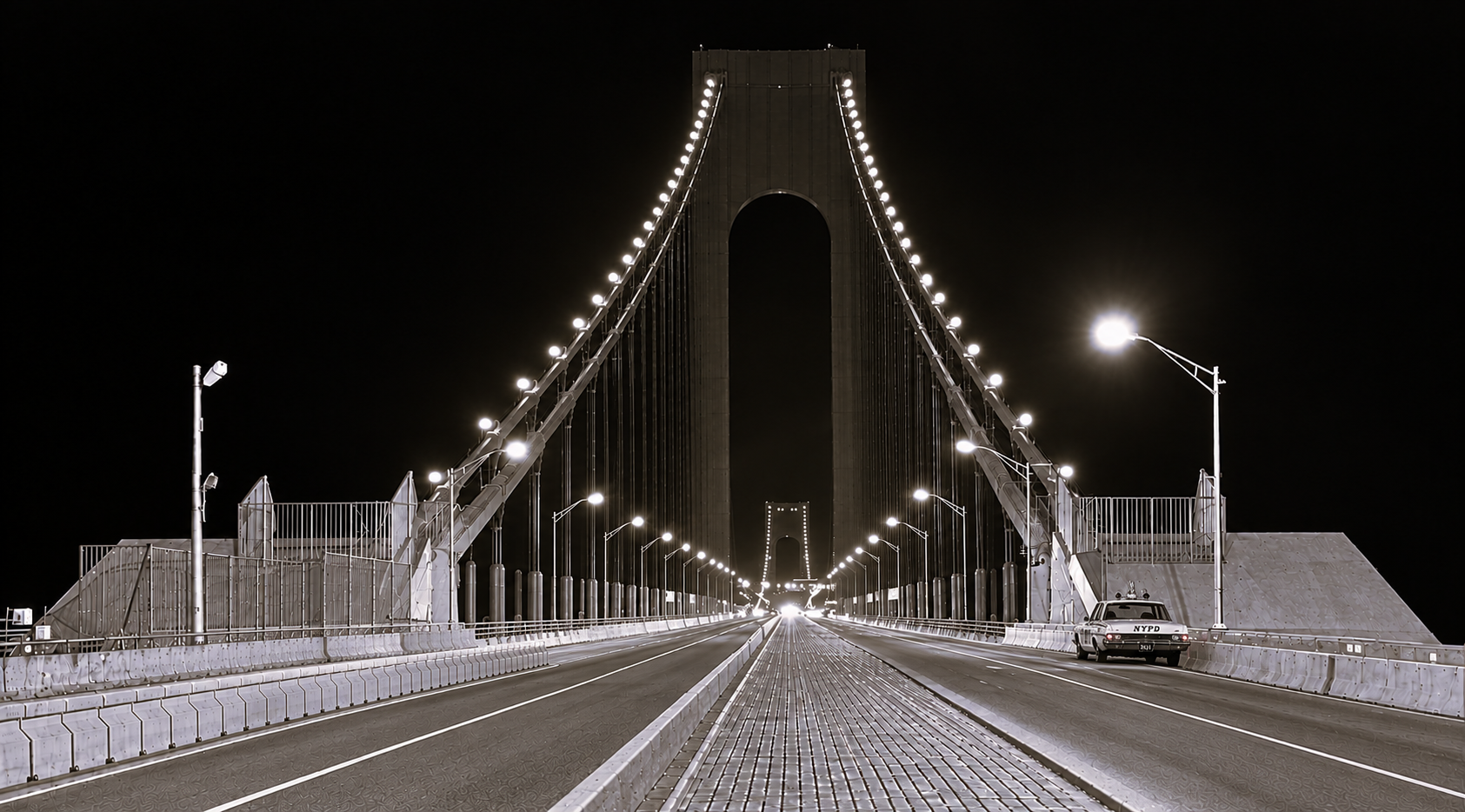
The cop said, “Son, I need you to come back here onto the road.”
“No, I’m not doing that.”
“This bridge isn’t even open yet; no one’s allowed up here.”
“Go away.”
“I’m not going anywhere, son. What are you doing?”
His face was twisted, and his eyes screwed shut. “I’m killing myself. Gonna jump off the bridge.”
“No, you’re not. What’s your name?”
“Dominic.”
There was hardly room for him on the end of that steel girder, ten feet out from the roadway. Suspension cables rose from the beam and disappeared into the superstructure. The two cops were on the pavement, behind a guardrail. Glow from construction lights washed the scene.
Dominic had lost his shirt and his coat somewhere. All he wore was a wife-beater undershirt and gray dress slacks with no belt. He was nineteen or twenty; his black hair was greased back in a pompadour, and he wept as he embraced a wrist-sized cable.
The talking cop was Erik Jacobson. For generations, all the men in his family were NYPD. During the war, he was a Navy Seabee—Construction Battalion. Japanese would blow everything up, and Seabees would build it back. They came in right behind the Marines, sometimes before the shooting stopped. He joined the police force the day he got home.
“What’s your last name, Dominic?”
Dominic wiped the tears off his face with one hand while keeping his skinny arm wrapped around the cable. “Spinelli, but what do you care?”
Jacobson’s partner, Vinnie Bonamo, mumbled, “So we know what name to put on your fuckin’ toe tag.”
“Where you live, Dominic?”
“92nd Street.”
“What block?”
“Between 4th and 5th. Why?”
Bonamo said quietly, “There’s maybe three houses on that block.”
“We’re going to call your mother and let her know you’re up here.”
“Oh God, please don’t call my mother.” Dominic started crying again.
“Dominic, have you been drinking?”
Spinelli looked down at the Verrazano Narrows. Twenty-three stories down. Wind slapped at his trousers. “I only wish I was.”
In the smoothest voice he could find, Jacobson said, “Look at me, Dominic. Not down. You’re not going down there.”
Keeping his eyes on Spinelli, he said, just above a whisper, “I got street shoes on, Bonamo. You want to do this?”
“Fuck no. You know I don’t like heights.”
Jacobson shook his head. “Go get the fall protection stuff. And see if there’s any tennis shoes in the trunk. Radio for them to get his mother up here.”
Spinelli leaned out and looked down again. He was hanging on with just one hand.
“How old are you, Dom? Can I call you Dom?”
“It don’t matter,” he sniffed. “Call me whatever you want.”
“You got a girlfriend?”
“Not anymore, I don’t.”
Jacobson turned away and rolled his eyes.
Bonamo came up behind him. “No tenny shoes.”
Handed him a wide web belt with a steel ring on the back. Jacobson strapped it around his waist and cinched it tight.
“Hey, Dom. I’m gonna climb over this guardrail and join you out there.”
The breeze was in Jacobson’s face as Bonamo clipped on the safety rope.
It clicked like the click on the static line, and his mind flashed him back into the door of that C-47 over the South Pacific. He fist-squeezed the tremors into submission. SeaBees were not supposed to jump out of airplanes, but there he was.
He took a deep breath and blew it out hard to drag himself back into the present. Shook out his shoulders once, then put a hand on the rail and climbed onto the catwalk.
Exposed on the narrow steel, he boomeranged back twenty years, looking down again at the jungle on some island he didn’t even know the name of. The night the parachute failed.
A construction vehicle passed by on the other side of the roadway. The steel thumped under their feet. Rattled him back to the present. Jacobson white-knuckled the rail behind his back. Dominic hugged the cable like a lover.
“Crazy how much this bridge moves, hey Dom?”
“Don’t come any closer or I’m going. I swear to God I’m going.”
Jacobson raised his free hand like he was stopping traffic at the Lincoln Tunnel.
“It’s okay, Dom. We can fix things with your girlfriend once we get down. What’s her name, Dom?”
“None of your fucking business.” He shut his eyes, and his face slackened. “Silvia.”
Sirens sounded in the distance, pitch rising as they got closer, then groaning to a stop. More red emergency lights rotated against the superstructure. Car doors slammed.
Bonamo said, “Hey. You’re hooked up.”
“Right.” Jacobson released his grip, felt a flick of vertigo, and grabbed for the rail again. He shut his eyes for a second, then focused on Spinelli out among the cables. He straightened up. Spit off to one side. Tested the traction under his leather soles. Then he relaxed his fingers once more.
A radio squawked. A voice from among the cars called, “They’re at the mother’s house.”
Spinelli said nothing as he released the cable and stepped off the girder like you’d step off a curb. Jacobson lunged, but it wasn’t even close. Spinelli disappeared into the darkness. For a blink, Jacobson thought he might go over, too. He dropped to a crouch; clutched both edges of the steel and froze.
Far below, running lights outlined a freighter working its way up the harbor. Wind thrummed in the cables, gulls cried, and engines of emergency vehicles rumbled on the concrete roadway. Crawling now, Jacobson inched backward, rivet heads chewing at his kneecaps. At the guardrail, he turned slowly, always keeping one hand on the steel. Hauled himself up and over.
He squatted there for minutes, both hands on the pavement, head hanging. Just breathing. Oblivious to the car exhaust in his nose and mouth. Bonamo unclipped the safety line and patted him on the back. “You good?”
When he looked up, Bonamo wouldn’t meet his eye. “They got into the house. There’s a dead girl on the kitchen floor, strangled with a man’s belt. The mother’s locked in the basement.”
Jacobson vomited onto his shoes.
Originally published in Thriller Magazine, October 2026