
Bob Anderson
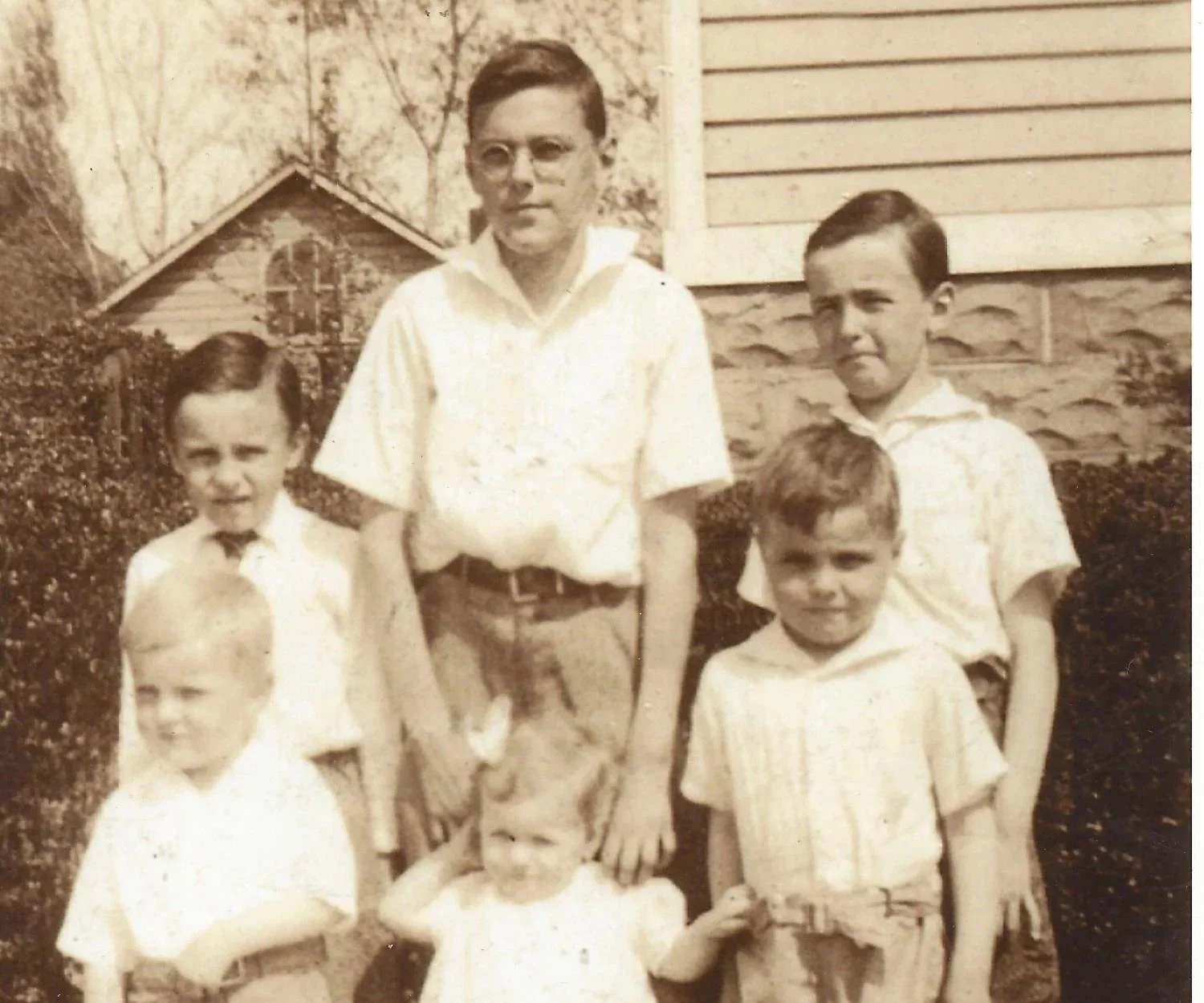
Dr. Robert Mapes Anderson, Ph.D., was Dad’s younger brother. I knew him as Uncle Bob. He was the last of the Anderson Brothers – my father’s generation, and he lived 94 years. He's the guy on the bottom right in the picture. Elanore, aka Aunt Tootsie, is the last remaining sibling.
He served in the US Army during the Japanese occupation. When his barracks building burned down, leaving him as the sole survivor, he felt touched by the hand of God and so became an evangelical Christian. Upon his discharge, Uncle Bob returned to Staten Island, NY, and joined the American Pentecostal movement.
For a time, he led the life of an ascetic and street corner preacher, much to the amusement and consternation of his mother and siblings. He ultimately married the daughter of the leader of his particular church and joined his in-laws’ family construction business.
Throughout the 1950s and most of the 60s, Uncle Bob swung a hammer and praised God around Staten Island. He also put himself through college with the help of the GI Bill. First at Wagner, then at Columbia, where he got his PhD in History. His doctoral dissertation was later published as “Vision of the Disinherited: The Making of American Pentecostalism.” It’s still available on Amazon in hardcover or paperback, $53.98 - $99.93.
He was known for some time as the world’s foremost authority on American Pentecostalism. He once told me, “Anyone can become a ‘world’s foremost authority.’ Just pick a really obscure subject, learn as much as you can about it, and write a book.”
Uncle Bob was always curious and impressionable, so the cultural upheaval of the '60s could not slip past him untasted. I remember one summer day in 1968, my parents were in Europe, and I was with my grandmother (Mom’s mom, Borghild) in her car on Staten Island. A long-haired, bearded person in shorts and sandals crossed the street in front of us, and Grandma said, “There’s your Uncle Bob.” I was astounded. I spun around to get another look, and she continued, “He’s turned into a damn hippie!”
More than just a damn hippie, Uncle Bob now called himself a Communist, became involved with the student anti-war movement at Columbia, and was present during the occupation of Hamilton Hall by Mark Rudd and the SDS.
The late 60s and early 70s were the years that I became politically aware. The Vietnam War was front and center every day. Combat footage was on the TV each night, and casualty reports were on the morning radio. Family gatherings became wonderfully entertaining. Uncle Bob was an anti-war commie; Uncle Don was a liberal who worked for the State Department; Uncle Gene was a WWII combat Vet and Warrant Officer in the Army Reserve; Dad was Goldwater Conservative, and Uncle Al just sat back silently.
I loved those days. Mostly, it was Dad and Uncle Bob going at it, arguing back and forth. They were both very smart, very well-informed, and very passionate. They were also great friends. I dreamed of the day when I would know enough to participate in those debates.
After earning his Ph.D., Uncle Bob became a history professor, of course. He taught at his alma mater, Wagner College, was active in the teacher’s union, and became Chairman of the History Department. In the early ‘80s, he and Aunt Ruth divorced, and he moved in with Dad (also recently single-ized). Two wild and crazy middle-aged guys in a bachelor pad at the end of the disco era. It didn’t last long, though.
The poverty of the acrimoniously divorced caused Uncle Bob to slide down that slippery slope into Capitalism. Still identifying as a man of the people, Dad bankrolled him into buying some Trump-owned apartments that were going condo on Grymes Hill. His plan was to renovate and flip them. This is when my adult relationship with Uncle Bob began.
I was a starving college student; he was a broke college professor, and we worked together a few days a week for about a year renovating those apartments. I learned all about how pros paint, tape, sheetrock, hang cabinets, and trim. I learned the top of the pecking order in construction is “a real mechanic,” a person who knows all the trades and can build an entire house with their own knowledge and skills. I learned that pre-hanging doors was a process introduced to the Staten Island homebuilding community by Hungarian refugee carpenters who escaped the failed uprising of 1956. I learned about the disdain for plywood when it was first introduced in the 1940s and many other anecdotes and tidbits from history, politics, and construction.
Uncle Bob went on to accumulate a little residential real estate empire. He taught my late brother Allan a lot about construction as well, and Al worked for him off and on for many years. I moved on to the corporate world but used Uncle Bob’s teachings to flip a few houses with my former wife. We drifted apart, mainly due to geography and other disparate influences, but I will always cherish the time we spent working together.
He once told me, “You know, Bruce, I realize everyone has to die eventually, but I'm hoping in my case, they’ll make an exception.”